
The digital settings we communicate in today are mathematically optimized for outrage.
Every scroll, notification, and trending topic is engineered to amplify division. Algorithms reward our sharpest reactions and penalize nuance, packaging complex structural challenges into digestible, hyper-polarized narratives. We see it happening in real-time: a simple local discussion about town zoning, traffic safety, or neighborhood parks quickly morphs into an ideological proxy war.
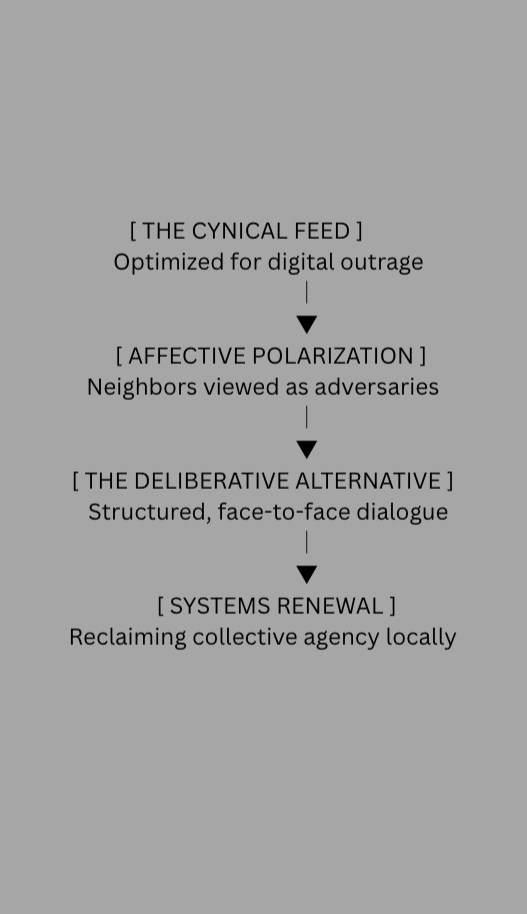
This is the reality of affective polarization—a state where we don't just disagree with our neighbors on policy; we begin to see them as entirely separate, oppositional forces.
When our communication spaces are built to divide us, the abstract debates about fixing our democratic institutions are no longer enough. The stagnation of our social and economic landscapes is directly tied to the collapse of our shared spaces. To drive true systems change, we have to change the pattern.
The cure shouldn’t be waited on at a national level—it needs to be built right on our own blocks.
The Power of the Structural Container
Humans are not inherently broken, but our current tools for public discourse are. When we strip away the screens and replace them with a deliberate physical environment, the dynamic completely shifts.
The empirical research of Dr. Alice Siu at the Stanford Deliberative Democracy Lab provides clear, undeniable data on this phenomenon. Through decades of global Deliberative Polling®, Dr. Siu and her team have demonstrated that when everyday citizens are brought out of their ideological bubbles and placed into structured, face-to-face deliberative settings, affective polarization dramatically decreases.
When people are given vetted, balanced information and a structured environment to converse, they don't magically agree on everything—but they begin to see the "other side" in a warmer light. Once that affective wall is dismantled, policy disagreements stop being fatal. We re-establish a baseline of mutual respect that allows us to actually solve problems together.
Moving Beyond the Screen
Reclaiming our collective agency means choosing where and how we meet. A kitchen table or a neighborhood salon isn't just a nostalgic concept; it is a structural alternative to a toxic system. By designing local containers for dialogue rooted in equity and justice, we bypass the digital noise and give agency back to the people most affected by local policy.
This is the foundation of our work at Pattern Change Lab. We believe that democracy is a muscle trained through local execution. Over the coming weeks, this series will lay out the precise blueprints for building these alternate spaces, managing localized conflict, and mapping your community's unique assets.
Your First Step: Observe the Creep
We are pacing this process gently. You don’t need to organize a town hall by tomorrow morning. This week, your only objective is to observe.
Identify one hyper-local issue on your street—whether it’s street safety, public green spaces, or school infrastructure. The next time you hear it discussed online or in casual conversation, notice how quickly national political party narratives try to creep in and hijack the reality of your block. Simply recognizing this pattern is the first step toward breaking it.
To prepare your own local framework, access your free copy of the Pattern Change Lab Global Action Toolkit PDF and flip to page 8 to review our four Deliberative Ground Rules.
Let’s get to work.